Slavery to our own selves and to our own passions is also slavery to things and to other people, who have the power to feed or starve those passions.
Limits are what makes free action possible. We exercise our freedom by liniting ourselves to one choice. There are many good you are free to enjoy to the extent that you commit to them, renouncing all others: a spouse, for instance.
—
Professing to be free, we have become slaves.
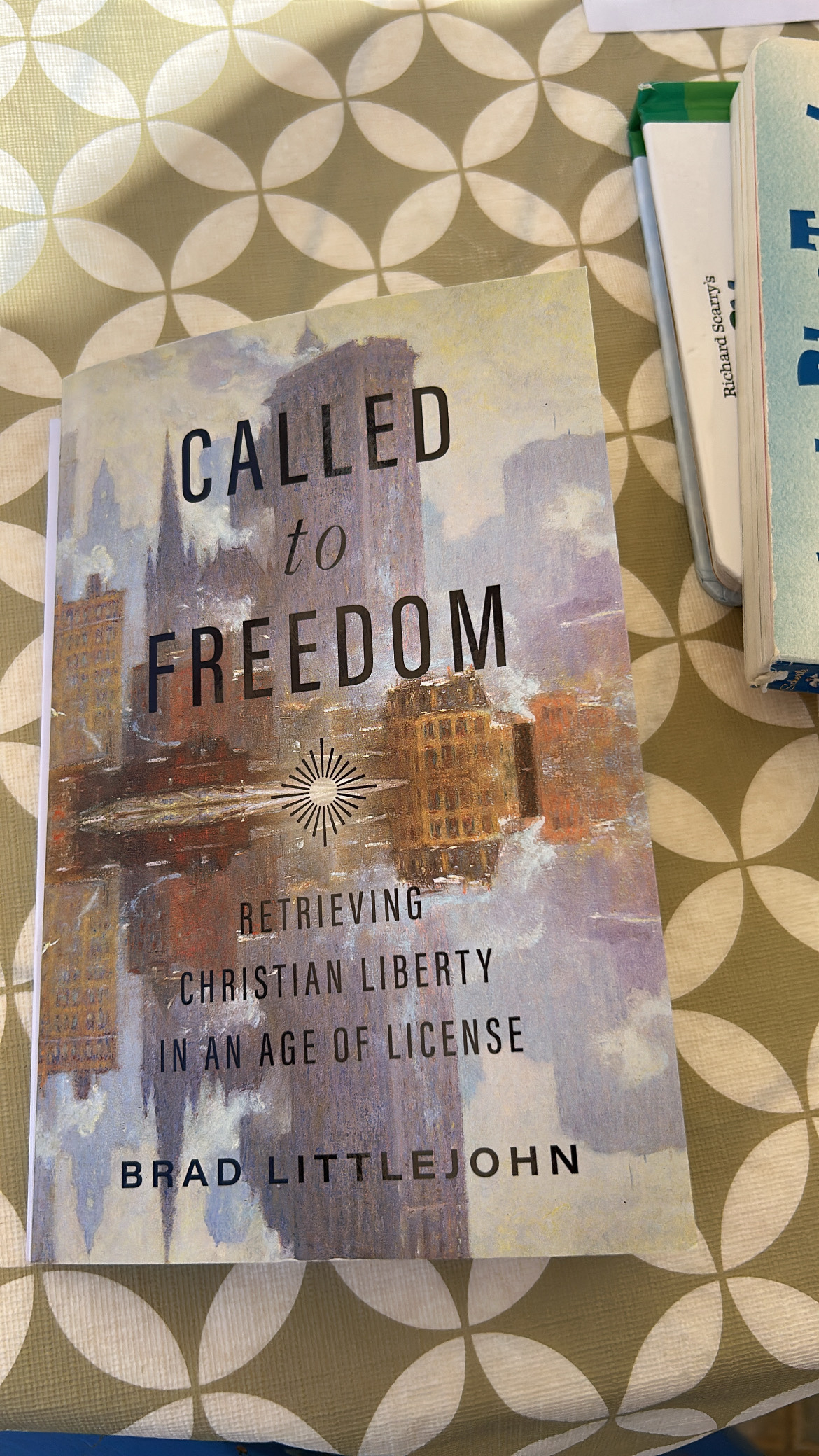
Brad Littlejohn, Called to Freedom
The great product designer Jony Ive, regretting his contributions to smartphone addiction:
But Ive is also clearly conflicted about his own role having of course designed the device which is now in billions of pockets, if not hands, at any given moment. He noted that even if there were no ill intentions in the creation of such products, there needs to be some level of responsibility for the outcomes.
The Wall Street Journal earlier reported that the device won’t be a phone, and that Ive and Altman’s intent is to help wean users off of screens.
WSJ
In my experience if you are trying to get a sense of where you are going to end up, you shouldn’t look at the technology, you should look at the people who are making the decisions, and you should look at what drives, motivates, and look at values.
Jony Ive, speaking perhaps more truthfully than he knows, in his recent promo with Sam Altman
The claim of inevitability is crucial to technology hype cycles, from the railroad to television to AI. “A key strategy for a technology to gain market share and buy-in,” the scholars David Gray Widder and Mar Hicks write, “is to present it as an inevitable and necessary part of future infrastructure, encouraging the development of new, anticipatory infrastructures around it.”
Nor is the infrastructure only physical. It has already been built in the minds of students, who are becoming informational lotus-eaters, addicted to immediate, effort-free homework answers and adequate-seeming essays on demand.
AI is not revolutionary. It’s a gimmick. It entices us with the prospect of sparing us drudgery, but it ultimately disappoints. AI apologists are like hucksters at a county fair, fast-talking about some newfangled marvel. Universities are their gape-mouthed marks, emptying their pockets even while they are unsure about what they are buying or whether students will use it to learn or simply cheat with.
If students want to do the work, then they don’t need help wanting it. No, the only task remains the paradoxical one identified as far back as in Plato’s Meno: Give students work they don’t know they need to do. And yes, help them want to do it.
I have found, to overcome students’ resistance to learning, you often have to trick them. There’s the old bait-and-switch of offering grades, then seeing a few students learn to love learning itself. Worksheets are tricks, as are small-group discussions and even a teacher’s charisma. I’m sure I have used baseball analogies in class, too. In the face of the difficulty of reforming students’ desires, you can trick yourself into believing you’re doing it, and sleep well at night. I don’t know anyone for whom it’s a straightforward task. It’s the challenge for any teacher, and AI offers a tempting illusion to students—and evidently to some teachers—that there could be a shortcut.
