Algebra is the offer made by the devil to the mathematician. The devil says: `I will give you this powerful machine, it will answer any question you like. All you need to do is give me your soul: Give up geometry and you will have this marvellous machine.’ (Nowadays you can think of it as a computer!) Of course we like to have things both ways; we would probably cheat on the devil, pretend we are selling our soul, and not give it away. Nevertheless, the danger to our soul is there, because when you pass over into algebraic calculation, essentially you stop thinking; you stop thinking geometrically, you stop thinking about the meaning.
I am a bit hard on the algebraists here, but fundamentally the purpose of algebra always was to produce a formula which one could put into a machine, turn a handle and get the answer.
Sir Michael Atiyah, Mathematics in the 20th Century
“I would say you haven’t the slightest idea about the valences of superiority and inferiority when you use the word ‘status.’ I would say you have tried to disguise a much better word with such euphemisms, the word… pride.” “There are some things in human society that can never be post-scarcity. For instance: status.” “Anti-social behavior covers it, when it comes to what the older, superstitious folk used to call evil.” “Pride, she whispered to herself. What a complicated word it was! She studied it, and contemplated it. A word with a long history, with both positive and negative valences, a tangle of cultural and religious significances.”
“Joyns realized that she wanted, very much, to believe this — her superiority to the rest of her fellows. But she caught herself. Was the Gentleman saying it because it was true, or was it a flattering lie he was using to worm his way into her mind?”
“But the truth is, he changed. He became lesser; a petty person, obsessed with crude status.”
“Posessiveness is miserliness. … Posessiveness substitutes things for people, despite the fact that things, though fun, are ultimately nothing and people are everything. The reason for this is that things cannot love you back.”_
Adam Roberts, on pride and status, in Lake of Darkness
Books I look forward to reading in the next couple of months:
- God and Humanity, by Gray Sutanto
- Immortal Souls: A Theological Anthropology, by Ed Feser
- Life on the Silent Planet: Essays on Christian Living from C.S. Lewis’s Ransom Trilogy
- Confessions, by St Augustine. Started it many times but never completed.
- After Stoicism, by Thomas Ward
- Engaging with Thomas Aquinas: An Evangelical Approach, by Leonardo de Chirico
- A Terribly Serious Adventure: Philosophy and War at Oxford, 1900-1960, by Nikhil Krishnan
Dawkins on revival and transgenderism
Richard Dawkins in The Spectator, on regretting that he identified himself as a cultural Christian:
In a recent interview, I imprudently said I was a “cultural Christian,” and I haven’t heard the end of it. I find myself unwillingly counted in the Great Christian Revival (translation, “We don’t actually believe that stuff ourselves, but we like it when other people do”) which is the subject of so much wishful thinking these days.
And on transgender ideology:
I’ll just support the claim that the trans-sexual bandwagon is a form of quasi-religious cult, based on faith, not evidence. It denies scientific reality. Like all religions it is philosophically dualistic: where conventional religions posit a “soul” separate from the body, the trans preacher posits some kind of hovering inner self, capable of being “born in the wrong body”. The cult mercilessly persecutes heretics. It abuses vulnerable children too young to know their own mind, encouraging them to doubt the reality of their own bodies, in extreme cases inflicting on those bodies irreversible hormonal, and even surgical damage.
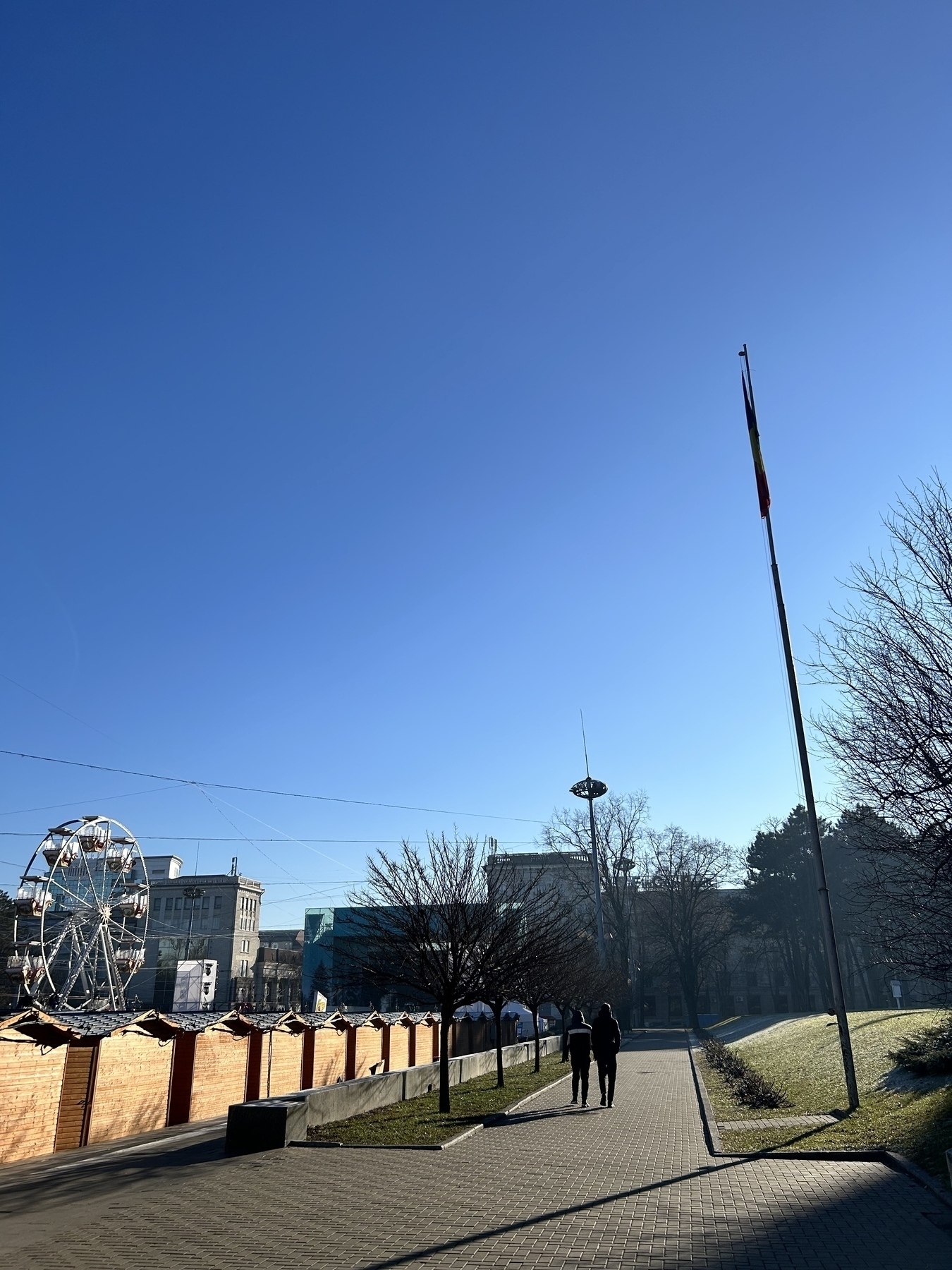
Downtown Chișinău, January 2025