← Home About Subscribe Archive Photos Also on Micro.blog
  • We should preach application and speak (e)vocatively to our congregation throughout the message. We should preach to our people the whole time we are preaching, and not only after we have walked through the text or proven our case of what the main point is.

    Preach the whole sermon, Andrew Ballard, 9Marks

    → 10:08 AM, Nov 20
  • Geerhardus Vos, by Danny E. Olinger

    Not a critical biography, but a very helpful one nevertheless. Vos is the father of the Reformed biblical theology movement of the 20th century, with all its strengths and weaknesses. His emphasis on eschatology has left a deep imprint on Westminster Seminary in Philadelphia, and through them on the rest of the Reformed and evangelical world.

    This biography chronicles Vos’s life and writings, his friendship with theologian Herman Bavinck and future US president Woodrow Wilson. Vos’s relationships and work were a great bridge between the Dutch Reformed churches of the Netherlands and American Presbyterianism at Princeton Seminary.

    Vos is clearly a towering figure to whom we owe much of the fruitfulness of eschatology-focused exegesis over the past century. We should be grateful for him and learn all we can from his labors. Without taking away from that, we should also remember he was a man of his time and he had his faults. Olinger clearly loves Vos and has fully bought into the program, but there is room for correction. For example, surely something can be learned from Jay Adams’s critique of the lack of application in redemptive-historical preaching, instead of dismissing it lightly. Olinger also shows no awareness of Vos’s weaknesses in systematics, nor of any negative effects of incipient biblicism among some of his students. It would be worth exploring how many theological controversies at Westminster in Philadelphia have to do with their emphasis (or over-emphasis?) on biblical theology.

    Overall, a great book about a great figure of the church, misunderstood in his time but rewarded with influence in the generations that followed him. Every Reformed preacher should know and use Vos.

    → 1:29 PM, Aug 24
  • You get 18 summers. Then they’re visiting. You get 940 weekends. Then they have their own. You get 6,570 bedtimes. Then silence. Time is the only real currency of parenthood. Spend it wisely. You can’t earn more.

    Robert Bortin

    → 9:58 AM, Aug 20
  • • See a need that matters to you. • Build the smallest, simplest thing that solves it. • Resist the urge to make it bigger. • Enjoy it.

    Do things that don’t scale, and then don’t scale

    → 9:42 PM, Aug 16
  • Politics is not hard because its principles are difficult to know. Politics is hard because it deals with an unwieldy number of variables, never exactly replicable, on a grand scale that have to be put into a practical syllogism in order to be applied.

    The essence of political liberalism, I have come to see, consists in the principalizing of context-specific, prudential conclusions. It essentially takes the conclusion of a practical syllogism and turns it into a major premise applicable to all societies despite their individual circumstances. Not only is it an abuse of reason and of the discipline of politics, but worse, it is inherently contrary to charity.

    On Baptist Establishment, Again, Brandon Corley

    → 7:56 PM, Jun 30
  • Willard’s foundation was about the kingdom of God as realism, and within that framework, the call of the Christian to be a disciple (i.e., apprentice of Jesus). In this sense, the controlling reality of Willard’s vision was the kingdom rather than discipleship, even though his view of disciples as apprentices advanced his view of the kingdom.

    On Comer’s rendition, disciple and discipleship are the foundation, and everything builds from this… what Comer has done is tried to put a Willardian structure on a Rob Bell foundation.

    The problem with advancing the kind of view of disciple and discipleship that Comer does is that it will never ultimately make sense of life in the church.

    Kyle Strobel on John Mark Comer

    → 9:28 AM, Jun 16
  • In such a world, the theology—and the priorities—of the Nicene Fathers and of a figure like Augustine is an important antidote to such falsehoods. They were not interested first and foremost in what worked to achieve some immanent goal. They were focused on how they might apprehend and then proclaim transcendent truth. Their preoccupation with the doctrine of God is therefore salutary and, particularly in the form of the Nicene Creed, something of an antidote to our modern self-absorption. And as we move from Nicaea to Constantinople in 381, Ephesus in 431, and Chalcedon in 451, the unfolding logic of God revealing itself in Christology can only deepen our wonder. What God is this?

    Carl Trueman, Nicaea and Augustine, Antidotes for our Age

    → 10:08 PM, Jun 7
  • Pursue friendships with those who are smarter than you and godlier than you, and you’ve got a massive advantage over others in your theological development.

    Mark Jones, The Importance of Friendship for Theology (2015)

    → 3:54 PM, May 29
  • The claim of inevitability is crucial to technology hype cycles, from the railroad to television to AI. “A key strategy for a technology to gain market share and buy-in,” the scholars David Gray Widder and Mar Hicks write, “is to present it as an inevitable and necessary part of future infrastructure, encouraging the development of new, anticipatory infrastructures around it.”

    Nor is the infrastructure only physical. It has already been built in the minds of students, who are becoming informational lotus-eaters, addicted to immediate, effort-free homework answers and adequate-seeming essays on demand.

    AI is not revolutionary. It’s a gimmick. It entices us with the prospect of sparing us drudgery, but it ultimately disappoints. AI apologists are like hucksters at a county fair, fast-talking about some newfangled marvel. Universities are their gape-mouthed marks, emptying their pockets even while they are unsure about what they are buying or whether students will use it to learn or simply cheat with.

    If students want to do the work, then they don’t need help wanting it. No, the only task remains the paradoxical one identified as far back as in Plato’s Meno: Give students work they don’t know they need to do. And yes, help them want to do it.

    I have found, to overcome students’ resistance to learning, you often have to trick them. There’s the old bait-and-switch of offering grades, then seeing a few students learn to love learning itself. Worksheets are tricks, as are small-group discussions and even a teacher’s charisma. I’m sure I have used baseball analogies in class, too. In the face of the difficulty of reforming students’ desires, you can trick yourself into believing you’re doing it, and sleep well at night. I don’t know anyone for whom it’s a straightforward task. It’s the challenge for any teacher, and AI offers a tempting illusion to students—and evidently to some teachers—that there could be a shortcut.

    ChatGPT is a gimmick

    → 10:10 PM, May 24
  • In my experience if you are trying to get a sense of where you are going to end up, you shouldn’t look at the technology, you should look at the people who are making the decisions, and you should look at what drives, motivates, and look at values.

    Jony Ive, speaking perhaps more truthfully than he knows, in his recent promo with Sam Altman

    → 9:53 PM, May 22
  • The great product designer Jony Ive, regretting his contributions to smartphone addiction:

    But Ive is also clearly conflicted about his own role having of course designed the device which is now in billions of pockets, if not hands, at any given moment. He noted that even if there were no ill intentions in the creation of such products, there needs to be some level of responsibility for the outcomes.

    Just Jony

    The Wall Street Journal earlier reported that the device won’t be a phone, and that Ive and Altman’s intent is to help wean users off of screens. WSJ

    → 9:50 PM, May 22
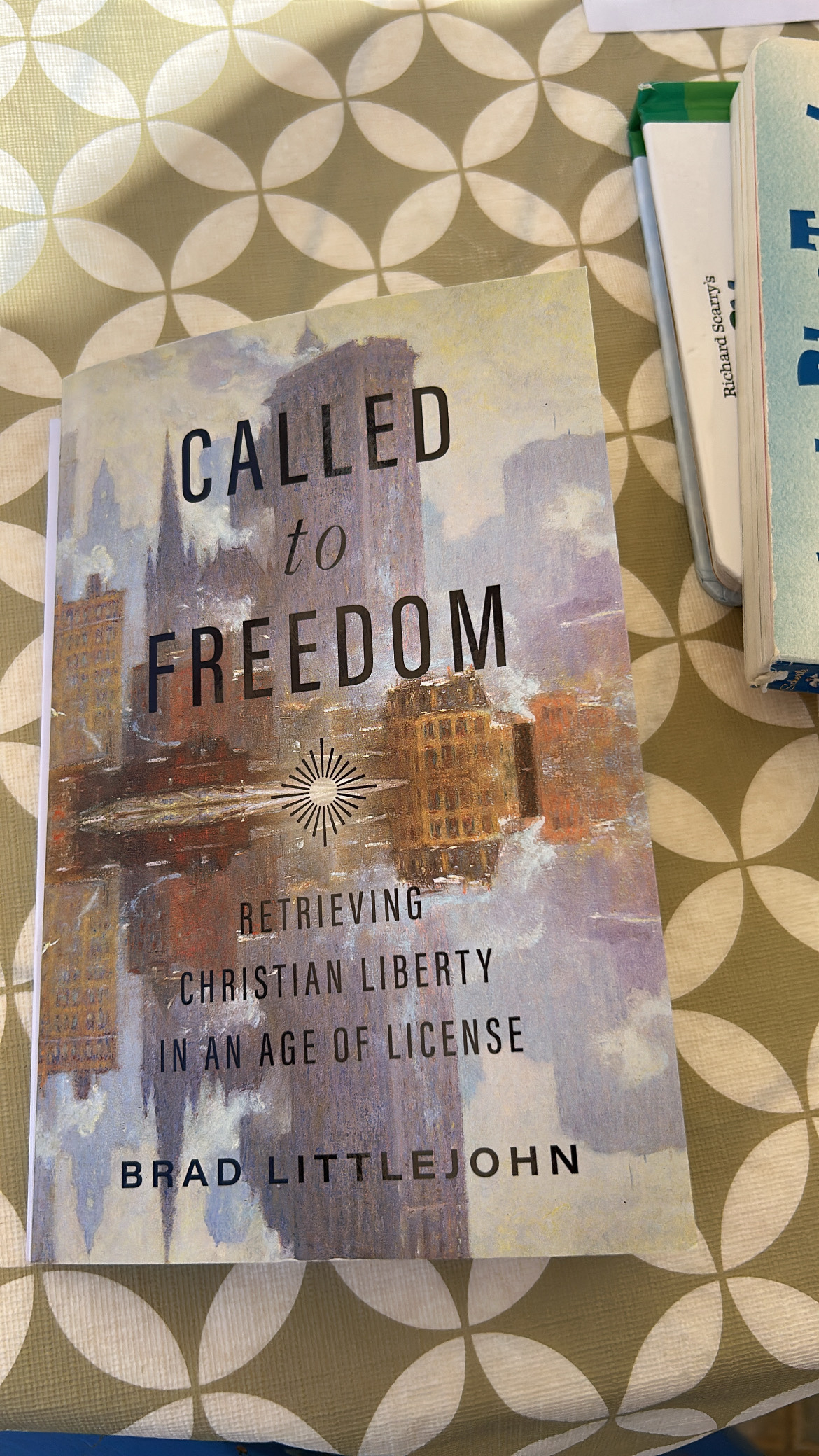
  • Slavery to our own selves and to our own passions is also slavery to things and to other people, who have the power to feed or starve those passions.

    Brad Littlejohn, Called to Freedom

    → 9:18 AM, May 20
  • Summer rain in Chișinău.

    → 7:36 PM, May 18
  • It was the Faustian bargain of modernity to try to make all men free by making all men consumers. As buyers, spenders, and choosers amid an ever-expanding array of products and as browsers through now-infinite digital spaces, we thought we would enjoy the original freedom and equality that were Adam and Eve’s the moment they first opened their eyes upon a garden of delights. But we are not in Eden, and even there, possibility was bounded by constraint; freedom was bounded by law.

    Brad Littlejohn, Called to Freedom (p. 5)

    → 7:31 PM, May 16
  • "Connecting" with an AI

    We live in a country full of people struggling to connect, full of people reaching into the dark, smiling as ghostly hands reach back. The issue is that what we think of as “AI” is nothing— large language models are built on both theft and our own words spit back out in new formations— people are asking for therapy from parrots and mirrors, listening to echoes and believing they’re Truth.

    In dating, they warn you that falling in love with someone’s potential is simply falling in love with yourself: the parts of them you’re imagining are simply projections of your own goodness radiating outward. I wonder if the same is true here.

    Deus Ex Machina

    → 2:18 PM, May 2
  • In response to the March layoffs, some former mission coworkers signed an open letter to PC(USA) leadership expressing concern that theologically conservative missionaries would take up the work that Presbyterian World Mission had abandoned.

    Christianity Today reporting on closure of the PCUSA missions agency

    → 1:03 PM, May 2
  • Ironically, the left, now alarmed by the federal government’s intrusive reach, bears direct responsibility for crafting the very legal weapons wielded against the universities it dominates. Almost four decades ago, progressive legislators demanded sweeping amendments to civil rights law, expanding federal oversight over higher education. The sequence of events reveals a cautionary tale of political hubris: progressive confidence that state power would reliably serve their ends overlooked the reality that governmental authority, once unleashed, recognizes no ideological master. Today’s circumstances starkly illustrate how expansive federal control over civil society, originally celebrated by progressives, returns to haunt its architects. The left’s outrage ought to focus not on this particular administration but on its own reckless empowerment of the state.

    John O. McGinnis, The Road to Campus Serfdom

    HT: Alan Jacobs

    → 8:15 PM, Apr 30
  • Train station, Chișinău.

    → 5:15 PM, Apr 28
  • The limits of AI

    Humans are distinguished by our ability to perceive reality. Those of us who consistently misperceive reality are regarded as incapacitated—that is, mentally ill.

    The goal of human knowing is always to know something about reality, regardless of whether that knowledge has operational value. By contrast, neither an animal nor an AI seeks the reality of the real. AI must employ symbols, which have no meaning except that assigned to them by someone outside the computer system.

    The AI paradigm reacts to stimuli in the form of sense-type data or website texts; it cannot react, except very indirectly, to any underlying reality. It does not know what it is doing.

    AI cannot advance human knowledge in any theoretical sense.

    Hype around the dangers of AI, though understandable, is misplaced. The real danger is not that some AI system will take over the world or go rogue like HAL. Rather, the real danger lurks in the complexification of society. As computer-based systems operate functions spanning ever more components of society, such as the power grid, the likelihood of malfunction naturally increases. The temptation will be to give AI systems more responsibility than they can handle, not from malicious intent, but through overconfidence.

    AI Doesn’t Know What It’s Doing

    → 11:53 AM, Apr 28
  • The anti-social social media

    But friends, viewed as entertainment sources rather than peers, are generally boring. They can’t consistently make content that outperforms with professionally made material, or compares favorably with all the content that all the world’s amateurs make available to algorithms. A platform of just friend-level content can’t survive in competition with content made expressly to be marketable as entertainment, or content revealed as attention-grabbing through algorithmic selection and feedback. Social media platforms don’t try to rebalance this but exploit it, encouraging users to further enjoy entertainment more than interacting with friends.

    But it turns out tech companies built social infrastructure only to undermine it, to help with dismantling it as a site of resistance to commercialization, commodification, and mediatization. There is more money in scuttling the “social graph” than leveraging it, because isolated people make for more dependable consumers.

    My intuition about social media has always been that it wanted you to hate your friends. It wanted you to see them at their worst, as showoffs seeking to stimulate envy at every turn.

    Rob Horning, Contentment

    → 10:44 AM, Apr 28
  • Instructions to avoid extinction

    Have the child. Practice the religion. Found the school. Support the local theater, the museum, the opera or concert hall, even if you can see it all on YouTube. Pick up the paintbrush, the ball, the instrument. Learn the language — even if there’s an app for it. Learn to drive, even if you think soon Waymo or Tesla will drive for you. Put up headstones, don’t just burn your dead. Sit with the child, open the book, and read.

    As the bottleneck tightens, all survival will depend on heeding once again the ancient admonition: I have set before you life and death, blessing and curse. Therefore choose life, that you and your offspring may live.

    Ross Douthat, An Age of Extinction Is Coming. Here’s How to Survive.

    → 10:10 PM, Apr 24
  • Marianne Brandon, a sex therapist, said she treats these relationships as serious and real. “What are relationships for all of us?” she said. “They’re just neurotransmitters being released in our brain. I have those neurotransmitters with my cat. Some people have them with God. It’s going to be happening with a chatbot. We can say it’s not a real human relationship. It’s not reciprocal. But those neurotransmitters are really the only thing that matters, in my mind.”

    NYT on “love” with ChatGPT

    HT: Alan Jacobs

    → 10:07 PM, Jan 22
  • The most popular podcaster in the world seriously discussing the possibility and meaning of Jesus Christ having come back from the dead.

    Maybe this is what it must have felt like in the 3rd and 4th century when Christianity conquered Rome. It was still pagan but all sorts of important figures were all of a sudden talking about it seriously in public as if it really mattered and if it were true it changes everything.

    → 12:05 AM, Jan 8
  • The Family and Technology

    The family — the forge of creation — is the foundation of society. As the site of the biological reproduction of the human race, this is obvious. Less obvious is the fact that in eras prior to ours, economic activity typically sat atop the organization of the family or household — oikos, as the Greeks called it. In fact, the art of managing household work — oikonomia — provided the etymological source of the term “economy.”

    “A family that does not or cannot control the information environment of its children is barely a family at all.” (Neil Postman)

    Conservatives today must reassert the authority of families and local communities over the technologies that shape their everyday lives. The aim should not be to impose one way of doing things on everyone, or to decide which technologies are right for all, but to restore power and responsibility to local actors.

    In practice, these innovations mean that families can no longer take responsibility for how they repair, maintain, or modify their vehicles, and can no longer rely on members of their community to assist them in doing so. Instead, they are subjugated to the whims of distant manufacturers and their dealer networks.

    High-speed internet, information technology, and smaller automated machines have made possible new forms of home production. In this third oikos, production is returning to the household, but this time it is woven into global supply chains, multinational firms, and just-in-time market production. Many white-collar workers are able to work from home via email, Zoom, and cloud-based collaborative applications. At the same time, many more kinds of home businesses — ranging from part-time cottage-industry Etsy shops to full-on niche industrial manufacturing using 3D printers, CNC machines, and CAD software— are starting to make sense. On the consumption side, the internet (soon to be married with drone delivery) is shifting value back into the home via online shopping, meal-kit and delivery services, platforms for in-home services ranging from plumbing to language tutoring, and improved options for home schooling and micro schooling.

    The future belongs to the family, because it is by nature the bearer and raiser of the next generation. The family begets the very beings who will come to witness, judge, and make the times ahead.

    Technology for the American Family

    → 9:27 PM, Jan 6
  • The idea that we now have a blend of Adam Smith, Ronald Reagan, and Milton Friedman in charge of the U.S. economy is, well, untrue. The idea that we now have Hitler, Smoot, and Hawley running the show is also untrue. Euphoria about our national politics is common to human nature when one’s preferred candidate wins. Doom & gloom is common when a candidate we loathe wins an election. And when you apply one of these extremes – euphoria or doom & gloom – to markets out of the context of politics, you are never going to be right. Ever. History is clear, so we must be smarter.

    David Bahnsen, at The Dividend Cafe

    → 11:11 PM, Jan 4
  • Downtown Chișinău, January 2025

    → 10:05 PM, Jan 3
  • Dawkins on revival and transgenderism

    Richard Dawkins in The Spectator, on regretting that he identified himself as a cultural Christian:

    In a recent interview, I imprudently said I was a “cultural Christian,” and I haven’t heard the end of it. I find myself unwillingly counted in the Great Christian Revival (translation, “We don’t actually believe that stuff ourselves, but we like it when other people do”) which is the subject of so much wishful thinking these days.

    And on transgender ideology:

    I’ll just support the claim that the trans-sexual bandwagon is a form of quasi-religious cult, based on faith, not evidence. It denies scientific reality. Like all religions it is philosophically dualistic: where conventional religions posit a “soul” separate from the body, the trans preacher posits some kind of hovering inner self, capable of being “born in the wrong body”. The cult mercilessly persecutes heretics. It abuses vulnerable children too young to know their own mind, encouraging them to doubt the reality of their own bodies, in extreme cases inflicting on those bodies irreversible hormonal, and even surgical damage.

    → 10:02 PM, Jan 3
  • Books I look forward to reading in the next couple of months:

    • God and Humanity, by Gray Sutanto
    • Immortal Souls: A Theological Anthropology, by Ed Feser
    • Life on the Silent Planet: Essays on Christian Living from C.S. Lewis’s Ransom Trilogy
    • Confessions, by St Augustine. Started it many times but never completed.
    • After Stoicism, by Thomas Ward
    • Engaging with Thomas Aquinas: An Evangelical Approach, by Leonardo de Chirico
    • A Terribly Serious Adventure: Philosophy and War at Oxford, 1900-1960, by Nikhil Krishnan
    → 4:58 PM, Jan 3
  • “I would say you haven’t the slightest idea about the valences of superiority and inferiority when you use the word ‘status.’ I would say you have tried to disguise a much better word with such euphemisms, the word… pride.” “There are some things in human society that can never be post-scarcity. For instance: status.” “Anti-social behavior covers it, when it comes to what the older, superstitious folk used to call evil.” “Pride, she whispered to herself. What a complicated word it was! She studied it, and contemplated it. A word with a long history, with both positive and negative valences, a tangle of cultural and religious significances.” “Joyns realized that she wanted, very much, to believe this — her superiority to the rest of her fellows. But she caught herself. Was the Gentleman saying it because it was true, or was it a flattering lie he was using to worm his way into her mind?” “But the truth is, he changed. He became lesser; a petty person, obsessed with crude status.” “Posessiveness is miserliness. … Posessiveness substitutes things for people, despite the fact that things, though fun, are ultimately nothing and people are everything. The reason for this is that things cannot love you back.”_

    Adam Roberts, on pride and status, in Lake of Darkness

    → 4:48 PM, Jan 3
  • Algebra is the offer made by the devil to the mathematician. The devil says: `I will give you this powerful machine, it will answer any question you like. All you need to do is give me your soul: Give up geometry and you will have this marvellous machine.' (Nowadays you can think of it as a computer!) Of course we like to have things both ways; we would probably cheat on the devil, pretend we are selling our soul, and not give it away. Nevertheless, the danger to our soul is there, because when you pass over into algebraic calculation, essentially you stop thinking; you stop thinking geometrically, you stop thinking about the meaning.

    I am a bit hard on the algebraists here, but fundamentally the purpose of algebra always was to produce a formula which one could put into a machine, turn a handle and get the answer.

    Sir Michael Atiyah, Mathematics in the 20th Century

    → 10:28 AM, Jan 3
  • Boredom and reading in the 21st century

    “Boredom was what the people of the Rerenaissance Age used to call ‘depression’, and where in twenty and twenty-one the tendency was to medicate this condition…” “I’ve had AIs read out really quite lengthy antique texts to me, though it gets dull very quickly. How the antiques managed, without picture and motion and affect, with just these barebones sigils in great long spooling lines, I’m not sure! They must have had greater tolerances for boredom than modern folk…. I mean, it’s still pretty boring, to be honest, sitting there whilst some AI reads some interminable antique text. Why were they so long, that’s what I want to know?”

    Adam Roberts, Lake of Darkness

    → 8:37 AM, Jan 3
  • Big believer in this: Be A Property Owner And Not A Renter On The Internet

    → 8:36 AM, Jan 3
  • “We are a self-indulgent, trivializing and trivialized culture. … We think games and pastimes and pleasures are the limit of human possibility. We deserve all that is coming.”

    Adam Roberts, Lake of Darkness

    → 11:39 PM, Jan 2
  • RSS
  • JSON Feed
  • Micro.blog